
Project Embrace
Creating a Generation of Youth Mental Health Champions.
Millions of young Nigerians are silently carrying mental health burdens they cannot name, in schools and communities where no one is trained to notice, respond, or care.
Project Embrace is closing that gap: placing a world-class mental health (MH) resource directly in schools and communities, building a generation of trained peer champions, equipping teachers with first aid skills, and establishing sustainable local support structures that outlast the project itself.
Project Embrace is closing that gap: placing a world-class mental health (MH) resource directly in schools and communities, building a generation of trained peer champions, equipping teachers with first aid skills, and establishing sustainable local support structures that outlast the project itself.
Embrace Your Mind
Embrace Your Mind: A Mental Health Guide for Young People is a culturally grounded and youth-friendly mental health resource developed by the Mental Health for Youth Initiative (MHYI) in collaboration with the Federal Ministry of Youth Development.
Written in clear, accessible language and grounded in evidence, the guide helps young people understand what mental health is, recognise the signs of struggle in themselves and others, and take meaningful steps towards support and healing.
It carries the personal foreword of Nigeria’s Honourable Minister of Youth Development, and has been reviewed and endorsed by leading psychiatrists, clinical psychologists, and counsellors across Nigeria.
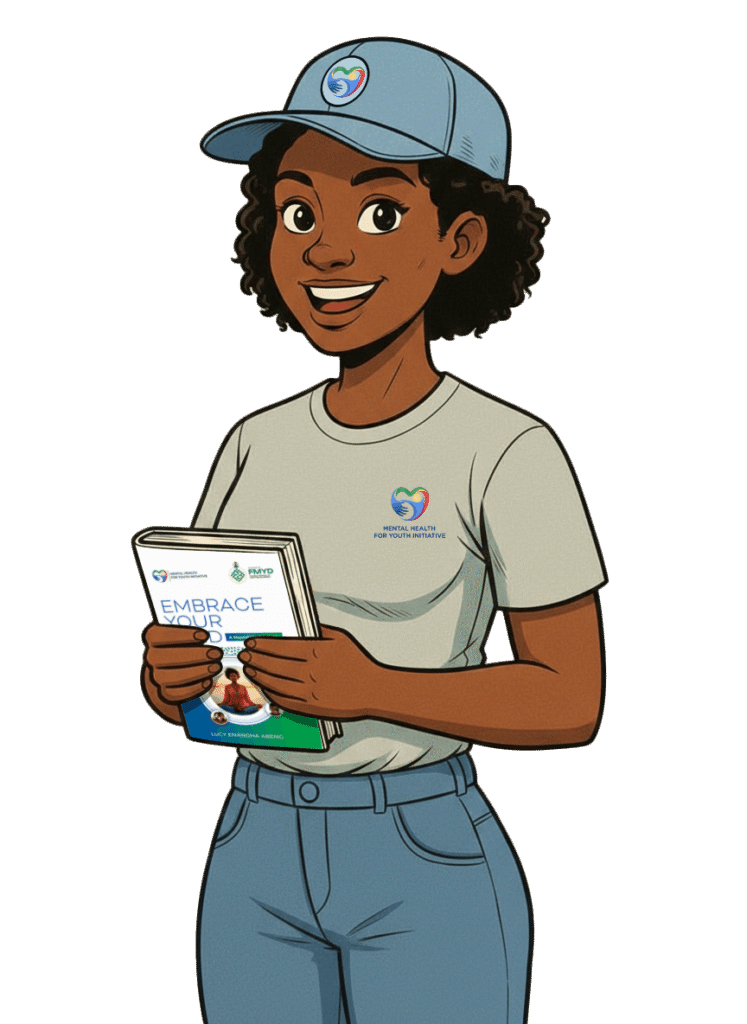
Project Embrace turns NYSC corps members into mental health frontliners — equipping them to walk into schools, communities, and youth spaces and deliver the awareness, support, and tools that too many young people have never had access to.
How it works -
Step by Step
Step 1
Train the trainers
Corps members are selected, trained, and deployed into schools and communities across 3 pilot states
Step 2
Build inside communities
Corps member leads teams that train Teacher–Guardian First Aider Clubs, equipping school staff to recognise mental health challenges, counsel students, and create institutional referral pathways that outlast the project.
Step 3
Activate peer leadership
200–350 Youth Champions are identified and supported to provide peer support, reduce stigma from the inside, and connect their peers to help.
Step 4
We put resources in young people's hands
18,000 youth-friendly workbooks and 1,800 facilitator guides are distributed directly into schools and communities so the knowledge stays long after the sessions end.
Step 5
We follow the data
Baseline and endline research across the 18 LGAs, generates the state-level evidence needed to influence policy, strengthen systems, and scale what works.

What the research aims to achieve
Project Embrace is not only a community intervention. It is a national evidence-building exercise. The data collected will be used to:
Capture the state of mental health among young Nigerians
Especially in rural, peri-urban, and low-income communities — populations that are systematically excluded from existing research
Build one of the most comprehensive community-level youth mental health datasets in Nigeria
Tracking knowledge, stigma, and help-seeking behaviours at baseline and end-line
Produce state-level youth mental health profiles
For FCT Abuja, Rivers State, and Ondo State — giving each state government actionable, localised data on the young people in their care
Advocate for mental health integration in the national school curriculum
Using project evidence to make the case for mental health education as a formal and funded part of young Nigerians' schooling
Inform the design of future mental health programmes and policies
Ensuring that the next generation of youth mental health interventions in Nigeria is built on real community evidence, not assumptions
Position Project Embrace as a tested, replicable model
For government adoption and donor scale-up across additional states
Every data point collected is a young Nigerian's experience — turned into evidence that demands a policy response
At its core, Project Embrace aims to create lasting impact by empowering young people as mental health champions, increasing early access to support, and driving evidence-based advocacy for improved youth mental health systems.